
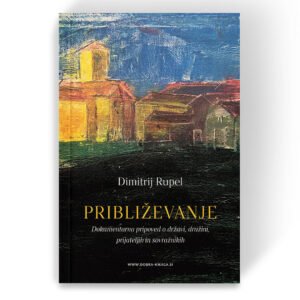
Brief content of the book
In Priblizjevanje, which Rupel has repeatedly announced as his last book (although this prediction will most likely not come true), the author – especially in the first part – is unforgivingly personal, otherwise critically assessing the development of the country that he helped to establish and served as foreign minister for a decade. Rupel presents the period after independence with various – sometimes shocking – details, but mainly divides it into an encouraging period until 2008 and a more difficult later period, characterized by wars that – at the end of the Cold War – we believed would not happen. Rupel is interested in the end of the end of the Cold War, which of course means that the politics that the famous and renowned German lawyer and philosopher Carl Schmitt called the antithesis between friends and enemies is being repeated. Rupel warns, among other things, that it is a cultural struggle in which – on the side of power and authority – counter-factual statements and fake news prevail.
Writer’s biography
Dimitrij Rupel was born on 7 April 1946 in Ljubljana, where he graduated (1970) from the Faculty of Arts. He received his doctorate in sociology from Brandeis University in Boston, USA, on 30 May 1976. Dr. Dimitrij Rupel became a full professor at the University of Ljubljana in 1992. He was one of the founders of Nova revija and also its editor-in-chief. In 1989, he became the president of the Slovenian Democratic Union (SDZ) and vice-president of the Democratic Opposition of Slovenia (DEMOS). In the first half of 2008, he chaired the General Affairs and External Relations Council (GAERC) of the European Union. Dimitrij Rupel is the author of many works of fiction. He described his personal experience of the Slovenian spring in the book The Secret of the State (1992). Rupel’s most recent books are Iron and Velvet (2017), Will We Be Prussians or Russians? (2018), Images from Reality (2022), The Meaning of Independence (2023) and Leaders of Slovenia (2024). Dimitrij Rupel is Professor Emeritus at the Nova Univerza.
Book reviews
When we think that Dimitri Rupel has run out of important material after 83 books, he surprises us with the extensive and content-rich “Approach”. With the help of the writer, the reader “easily” walks from Austro-Hungarian Vienna, through his father’s partisan story to Tito, democratization, independence and independent Slovenia. There is also no shortage of revelations of very personal matters in connection with his deceased wife Marjetica. In short, an interesting and also tense read that does not leave us indifferent for a moment!
— mag. Igor Omerza
Rupel’s research and approach to Slovenian life under socialism and during the founding of the state is characterized by an approach that in social science is called participant observation . There are not many such observers or researchers, whom Rupel and the writer of these lines call the “great generation”. In Approaching , I recognize events that I myself witnessed and about which I can say that they are presented in a reliable manner. The narrative is particularly exciting because it is documented with personal, and in the first part also family, experiences. Otherwise, the book could also be called distancing , as it reports on the current denial and evasion of the values that established and consolidated Slovenian statehood. Rupel’s work is of great importance for the study of international relations, and the author’s discussion of the views of the famous German lawyer Carl Schmitt is also interesting, which concludes that politics is sooner or later the antithesis or confrontation between friends and enemies.
— Prof. Dr. Peter Jambrek
Dimitrij Rupel’s writings are a reflection of his personal journey, his family’s history, and his thoughts on the Slovenian state. His works always bring important insights into the internal and external challenges that Slovenia faced on its path to independence and in the period after it. In this latest book, the author’s personal note stands out, which can also be provocative and polemical. As such, it opens up a space for discussion and offers an opportunity to reflect on what it means to be a small, recently established state in the increasingly complex world of global politics.
— Dr. Igor Senčar
Author’s comment about the book
Before October 2022, I could not write about some personal upheavals and about a different life than the one connected with diplomacy or politics. I intended to describe a different life in my “last book”, which I hesitantly titled Approaching. Perhaps this book is not just the latest, but truly the last. If so, there is no threat of a lack of reading, as a large number of books are published in Slovenia. When I (at the behest of the Golob government) headed the Public Book Agency for a short time, I repeatedly asked myself the question: what do Slovenian authors and Slovenians in general have important to say to the world? Perhaps the reason for the decline in interest in reading, which we hear about more and more often, is also that books are not interesting enough for readers? And what is interesting and what is necessary to say?
The first condition for interestingness is a truthful confession, which was drastically tested in 2018 by the German journalist Relotius, and the cover of the German weekly magazine reminded him of its founder’s motto: to say what is! I have witnessed many similar cases in Slovenia, and the most entertaining was a guest-written article by a foreign policy correspondent who in 2002 described in detail a dinner with the Danish Queen, which was canceled because negotiations in the EU dragged on late into the night. Today, truthful reports are more the exception than the rule. How can one accept and understand the Prime Minister’s fabrication that von der Leyen’s letter about the unacceptability of Commissioner candidate Vesel does not even exist?
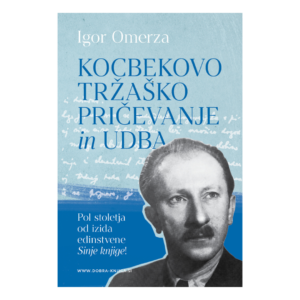
In Priblizevanje I write about my father, mother, brother and wife. Without truthfulness, especially because they are all deceased, this is not possible at all. How difficult it is to tell the truth and nothing but the truth, say the “heroes” of Omerz’s books about Udba. Although there are authentic documents in the Archives of Slovenia, some claim that they never collaborated with Udba. Slovenian books are sometimes uninteresting because they are silent about what is. Or they contain untruths.
In my “last book”, I also write about the wars in Yugoslavia, on the territory of the former Soviet Union, in Ukraine and in the Middle East. Slovenians have a lot to say about wars, their victims, winners and losers. The second most important thing is the independence, about which some prominent citizens lie, that it never happened at all; that it happened in 1945 and that it in no way deserves its own museum, which was decided by the previous government. At the time when I was writing my “last book”, I also experienced shameless statements that society, and especially TV Slovenia and the police, should be cleansed of people who found themselves in their positions before Golob’s government. Otherwise, I want to reach as many readers as possible with the help of the documentary story Priblizevanje .
Only logged in customers who have purchased this product may leave a review.
Reviews
There are no reviews yet.