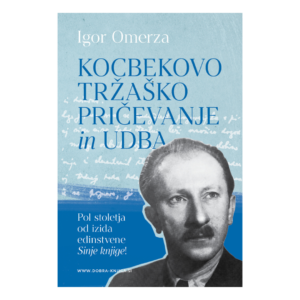
It has been half a century since the publication of Pahor-Rebula’s book Edvard Kocbek – a witness of our time. The most important part of this book is Edvard Kocbek’s self-interview, as he asked himself questions and his answers are something unique in our recent history, as he, as one of the leaders of the resistance against the occupier, exposed the interwar partisan terror and the post-war mass murder of unarmed Home Guardsmen.
In the book, the author first shows the massive UDBA stalking of Edvard Kocbek. UDBA, or at that time Ozna, had already initiated the investigation into him in 1944, called it Bohinjski, and then did not let him out of the secret police until his death. Edvard Kocbek was the most closely monitored individual in the communist history of Slovenia. In describing UDBA’s stalking of Kocbek, the author also documents how the secret police monitored his death and reported it to, among others, Milan Kučan.
Then we learn how Boris Pahor (stalked by Udba as Jambor) founded the magazine Zaliv in Trieste and how it also began publishing books, the so-called Kosovel’s Library. And the sixth in a row was the aforementioned book Edvard Kocbek – a witness to our time. We further learn how Boris Pahor tried for five years (from January 1970 to January 1975) for his friend Edi to finally agree to write a text about the interwar subjugation of the Liberation Front, the post-war massacre of the Home Guards, and then he actually did it, in one week.
The aforementioned testimony then saw the light of day in printed form on March 18, 1975. The writer meticulously dissects the unique content and is impressed not only by the powerful interior, but also by the literary beauty of the otherwise political text. In doing so, he specifically analyzes the use or non-use of the word crime in the testimony itself, or in Kocbek’s letters and diary entry.
The writer continues by describing the reactions of the regime, the Udba and the media to the witness. Neither politicians nor the media could find a single good word for the aforementioned text and they used lies and fabrications to shame Kocbek. The journalist Ivo Vajgl and the writer Jože Javoršek (also an Udba informant with the code name Piette) were the ones who attacked Kocbek the most in the media, while the politician Milan Kučan was more lenient. If it had not been for the defense of the democratic Western press, especially the German writer, philanthropist and Nobel laureate Heinrich Böl, the witness Edvard might even have ended up in prison. The regime apparently did not dare to imprison him, but instead, judge Franc Miklavčič (stalled as Privesek) and journalist Viktor Blažič (stalled as Blaž) ended up in prison because they defended Edi Kocbek’s testimony in the Trieste (Pahorjev) Bay.
In the Epilogue, the writer notes that on the basis of this testimony by Kocbek, processes began in socialist Slovenia that ultimately led us to democratization and, consequently, independence. That is why, even after half a century, the Blue Book, as the editors of this “blue book” Boris Pahor and Alojz Rebula, a little unjustly (it drags quite a bit!) but beautifully called it, remains a unique and historic Slovenian document, and its magnificence will remain for the next half century and beyond, or as long as the Slovenian nation, so dear and worthy of freedom to Kocbek, Pahor and Rebula, the creators of the brilliant Blue Book, exists!
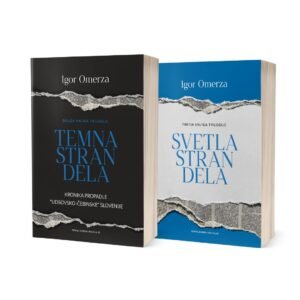
The book consists of 150 pages, with many photographs and facsimiles of UDBA documents. The book will be published on March 18, 2025, exactly on the half-century anniversary of the publication of Pričevalca našega časo in Trieste. In fact, it is the writer’s/Omerz’s literary tribute to this venerable anniversary!
The premiere presentation of the book will be on March 18, 2025, at 11 a.m., in the hall of the Slovenske matica, Kongresni trg 8. You are invited!

Reviews
There are no reviews yet.